
Every home needs an electrical repair service at some point. Most homeowners don’t think about their electrical system until something goes wrong. A light starts flickering. A switch stops responding. Or worse, you catch a faint burning smell from behind the wall. These aren’t things you can afford to ignore. Electrical problems are among the most common home maintenance issues in India, and in older colonies across South Delhi like Greater Kailash, Defence Colony, and Lajpat Nagar, outdated wiring makes these issues even more frequent. According to the Central Electricity Authority of India, faulty household wiring is one of the leading causes of residential fires in India.
This guide walks you through 10 of the most common electrical problems we encounter every day at Fixify: what causes them, how to spot them early, and what you should (and shouldn’t) try to fix yourself. If you’re in South Delhi and need help fast, you can book a certified electrician through our electrician services and get someone at your door within 30 minutes.Why Do Electrical Problems Happen in the First Place?
Table of Contents
- 10 Common Electrical Problems at Home - Causes and Fixes
- 1. Frequent MCB / Circuit Breaker Tripping
- 2. Electrical Outlets Not Working
- 3. Flickering or Dimming Lights
- 4. Burning Smell from Outlets or Switches
- 5. Getting an Electric Shock from a Switch or Appliance
- 6. Unusually High Electricity Bill
- 7. Switches or Fans That Don't Respond
- 8. Sparking from a Plug or Socket
- 9. Light Bulbs Burning Out Too Quickly
- 10. A Switchboard or Panel That Gets Hot
- What You Can Fix Yourself and What You Absolutely Shouldn't
- 7 Electrical Safety Tips Every Homeowner Should Follow
- When to Call an Electrician Immediately
- Why Homeowners in South Delhi Trust Fixify for Electrical Repairs
- Frequently Asked Questions
- Final Thoughts
Before we dive into specific problems, it helps to understand why they happen. A large number of homes in Delhi, particularly in older residential areas, are still running on wiring that’s 15 to 25 years old. That wiring wasn’t built to handle today’s electrical load: multiple air conditioners, smart appliances, high-wattage geysers, and constant phone charging.
Here are the most common reasons electrical problems develop over time:
- Circuit overloading: Too many appliances drawing power from a single circuit
- Ageing wiring: Aluminium wiring from the 1980s and 90s was never replaced with copper
- Monsoon damage: Moisture and water seepage silently deteriorate insulation and connections
- Voltage fluctuation: Frequent power surges are a known issue across Delhi neighbourhoods
- Unqualified repairs: Past DIY fixes or unlicensed electricians who didn’t do the job properly
10 Common Electrical Problems at Home – Causes and Fixes
Let’s go through each one in detail. For every problem, you’ll find a quick-reference table followed by a clear explanation.
1. Frequent MCB / Circuit Breaker Tripping
| Severity | High |
| Warning Signs | The main switch or MCB trips repeatedly, cutting power to part or all of your home |
| Root Cause | Circuit overload from too many appliances, or a short circuit somewhere in the wiring |
| How to Fix It | Unplug some appliances and reset the MCB. If it trips again, immediately stop. Don’t keep resetting it. Call a certified electrician. |
A tripping MCB is your circuit’s way of protecting itself. It’s a safety device, not a problem to override. If yours trips regularly, the underlying cause is almost always either too much load on a single circuit or a fault in the wiring. Neither of these is something you should try to fix yourself.
2. Electrical Outlets Not Working
| Severity | Medium |
| Warning Signs | A socket or plug point is completely dead appliances don’t power on when plugged in |
| Root Cause | A tripped GFCI outlet, a loose wire connection behind the socket, or a damaged outlet |
| How to Fix It | Look for a GFCI outlet nearby with a reset button and press it. If that doesn’t help, the wiring behind the socket needs to be checked professionally. |
This is one of the more common calls we receive. People assume the appliance is faulty, but often it’s the socket. GFCI outlets (common in kitchens and bathrooms) have a built-in reset button. If it’s a regular outlet that’s dead, it’s almost always a loose or disconnected wire behind the plate.
3. Flickering or Dimming Lights
| Severity | Medium |
| Warning Signs | Lights flicker, dim, or fluctuate especially when a heavy appliance like an AC or geyser turns on |
| Root Cause | Loose bulb or fixture connection, voltage fluctuation, or an overloaded circuit |
| How to Fix It | Lights flicker, dim, or fluctuate, especially when a heavy appliance like an AC or geyser turns on |
Occasional flickering when a large appliance kicks on isn’t always a serious issue; it can simply be a voltage dip on an overloaded circuit. But persistent flickering, or flickering in multiple rooms, points to something deeper: a loose main connection, a failing circuit, or outdated wiring that can’t handle the current load.
4. Burning Smell from Outlets or Switches
| Severity | High |
| Warning Signs | A burning or plastic-like smell coming from a switch, socket, or wall, sometimes accompanied by discolouration |
| Root Cause | Short circuit, overheated wiring, or damaged insulation inside the wall or behind the switch plate |
| How to Fix It | Switch off the circuit immediately and do not use that outlet. This is a fire hazard. Call an electrician the same day; do not delay. |
This one is serious. A burning smell from any electrical point is never normal and should never be dismissed as a minor issue. It means wiring or insulation is overheating and left unaddressed; it can start a fire inside your wall. Turn off the switch, stop using that point, and get it inspected immediately.
5. Getting an Electric Shock from a Switch or Appliance
| Severity | High |
| Warning Signs | A mild or strong jolt when touching a switch, tap, appliance casing, or metal surface near electrical points |
| Root Cause | Poor or absent earthing (grounding), damaged wire insulation, or current leaking through a faulty appliance |
| How to Fix It | Stop using the affected switch or appliance immediately. This is an earthing issue that requires a professional inspection; it’s a safety emergency. |
Electric shocks from switches or appliances are almost always caused by a grounding problem. In many older South Delhi homes, earthing was never installed properly or has degraded over the years. A shock is your body detecting current that shouldn’t be there. It can be mild, or it can be dangerous. Either way, it needs to be fixed, not ignored.
6. Unusually High Electricity Bill
| Severity | Low |
| Warning Signs | Your electricity bill spikes significantly without any clear change in usage patterns |
| Root Cause | Faulty appliances drawing excess current, ghost loads from old wiring, or a failing meter |
| How to Fix It | Unplug appliances one by one and monitor the meter. Getting an energy audit done on old or degraded wiring can waste a surprising amount of electricity. |
Not all electrical problems are dramatic. Sometimes the only sign of a wiring issue is a bill that keeps climbing. Old wiring with degraded insulation can create micro-leakages that waste electricity continuously. Replacing ageing wiring in an older home often leads to a 15–20% reduction in monthly bills.
7. Switches or Fans That Don’t Respond
| Severity | Medium |
| Warning Signs | A fan doesn’t spin, a light doesn’t turn on, or a switch clicks but produces no result |
| Root Cause | A faulty switch mechanism, a broken wire behind the switch box, or a tripped breaker for that circuit |
| How to Fix It | Check the MCB for that circuit first. If that’s fine, the switch or its wiring needs to be replaced by an electrician. |
Dead switches are frustrating and surprisingly common in homes with older switchboards. The switch mechanism itself wears out over time. In other cases, the wire behind the switch has simply come loose from its terminal. Both are straightforward fixes for a qualified electrician, but not something worth attempting yourself unless you know exactly what you’re doing.
8. Sparking from a Plug or Socket
| Severity | High |
| Warning Signs | A visible spark when plugging in or unplugging an appliance, especially if the spark is large or lingers |
| Root Cause | A small, brief spark when plugging in is normal. A large or repeated spark indicates a short circuit or a severely degraded socket. |
| How to Fix It | If the spark is small and momentary, it’s generally fine. If it’s large, loud, or accompanied by a smell, switch off that circuit and call an electrician. |
There’s an important distinction here: a tiny blue spark when you plug something in quickly is usually just the initial current draw, nothing to worry about. But a big, crackling, or repeated spark is a sign that the socket is damaged or the wiring has a fault. Old sockets, especially the ones that haven’t been replaced in 15+ years, are the most common culprit.
9. Light Bulbs Burning Out Too Quickly
| Severity | Low |
| Warning Signs | Bulbs fail far sooner than their rated lifespan, sometimes within weeks of being replaced |
| Root Cause | Voltage fluctuation, poor fixture wiring, or using the wrong wattage bulb for a fitting |
| How to Fix It | Install a voltage stabiliser for sensitive fixtures. Make sure you’re using the correct wattage. If the issue continues, the fixture wiring needs to be checked. |
If you’re replacing the same bulb every few weeks, the bulb isn’t the problem; your voltage is. Delhi’s power supply is prone to fluctuations, and repeated voltage spikes dramatically shorten bulb life. A stabiliser on affected circuits is a simple, affordable fix. If bulbs keep failing even with stable voltage, the fixture connection is worth inspecting.
10. A Switchboard or Panel That Gets Hot
| Severity | High |
| Warning Signs | The switchboard, distribution panel, or area around plug points feels warm or hot to the touch |
| Root Cause | Overloaded circuit, loose internal connections, or failing wiring behind the board |
| How to Fix It | This is a fire risk. Turn off the main switch for that board and don’t use it until a certified electrician has inspected and repaired it. |
A warm switchboard is not a minor inconvenience; it’s a warning sign. Heat from a switchboard means current is being lost somewhere it shouldn’t be, usually through a loose connection or overloaded wiring. In the worst cases, this is how electrical fires start inside walls. If your switchboard feels hot, treat it as an emergency.
What You Can Fix Yourself and What You Absolutely Shouldn’t
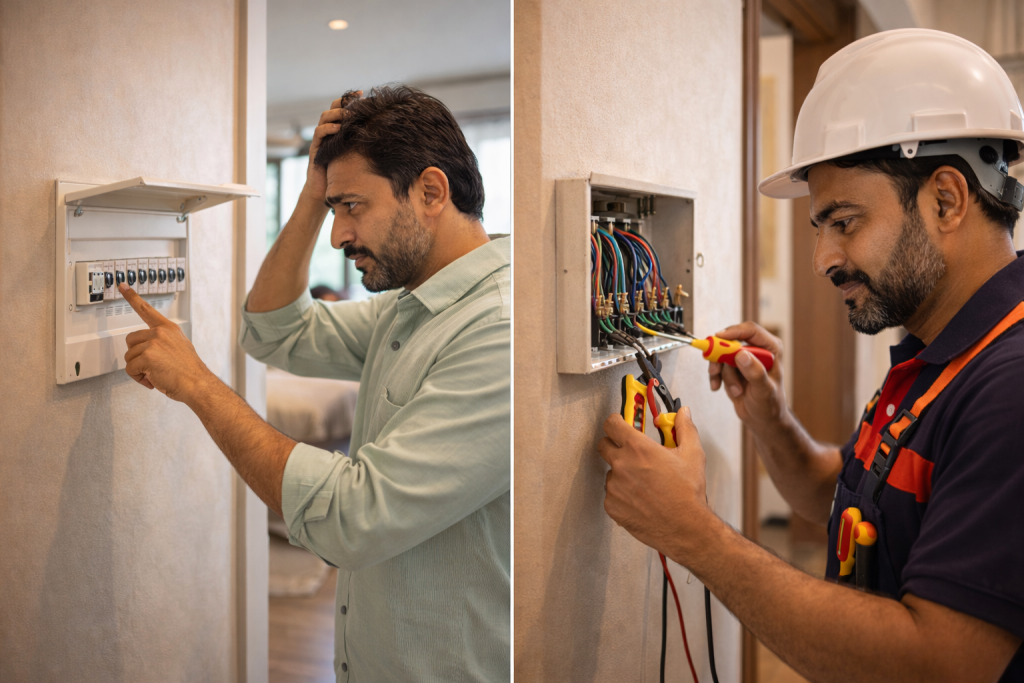
| ✅ Safe to Do Yourself | 🚫 Always Call an Electrician |
| Changing a light bulb | Repairing or replacing wiring |
| Resetting a GFCI outlet | Replacing or upgrading a circuit breaker |
| Tightening a loose plug connection | Fixing earthing or grounding issues |
| Installing a voltage stabiliser | Adding a new circuit or power point |
| Replacing an extension cord | Any work inside a switchboard or panel |
A general rule of thumb: if the job involves opening a switch plate, touching a wire, or working near a live circuit, it’s not a DIY task. The risk of electric shock or starting a fire isn’t worth the money saved.
7 Electrical Safety Tips Every Homeowner Should Follow
The Bureau of Indian Standards (BIS) recommends following IS:732 wiring standards for all residential buildings. Beyond that, these seven habits go a long way in preventing electrical problems before they start:
- Use MCBs (Miniature Circuit Breakers) on every circuit. Never use fuse wire as a substitute.
- Only buy ISI-marked wires and fittings. Cheap, unbranded wiring is a fire risk, and the savings aren’t worth it.
- Get your earthing checked every two years, especially in older homes. Earthing degrades silently.
- Don’t overload sockets. One appliance, one socket, avoids stacking adapters.
- Never touch a switch with wet hands. It sounds obvious, but this causes a significant number of household shocks.
- Get a full electrical inspection before the monsoon. Moisture and old wiring are a dangerous combination.
- Get a full electrical inspection before the monsoon. Moisture and old wiring are a dangerous combination.
When to Call an Electrician Immediately
Some electrical problems can wait a day or two. These cannot:
🚨 Call an Electrician Right Away If You Notice Any of These:
- Burning smell or visible discolouration from any switch or socket
- Sparking that is large, repeated, or accompanied by a smell
- Electric shock from any surface, switch, or appliance casing
- A switchboard or panel that feels hot to the touch
- An MCB that trips repeatedly within minutes of being reset
- Sudden power loss in a specific room or area of the house
Fixify offers emergency electrician service across South Delhi available every day, with a 30-minute response guarantee.
Why Homeowners in South Delhi Trust Fixify for Electrical Repairs
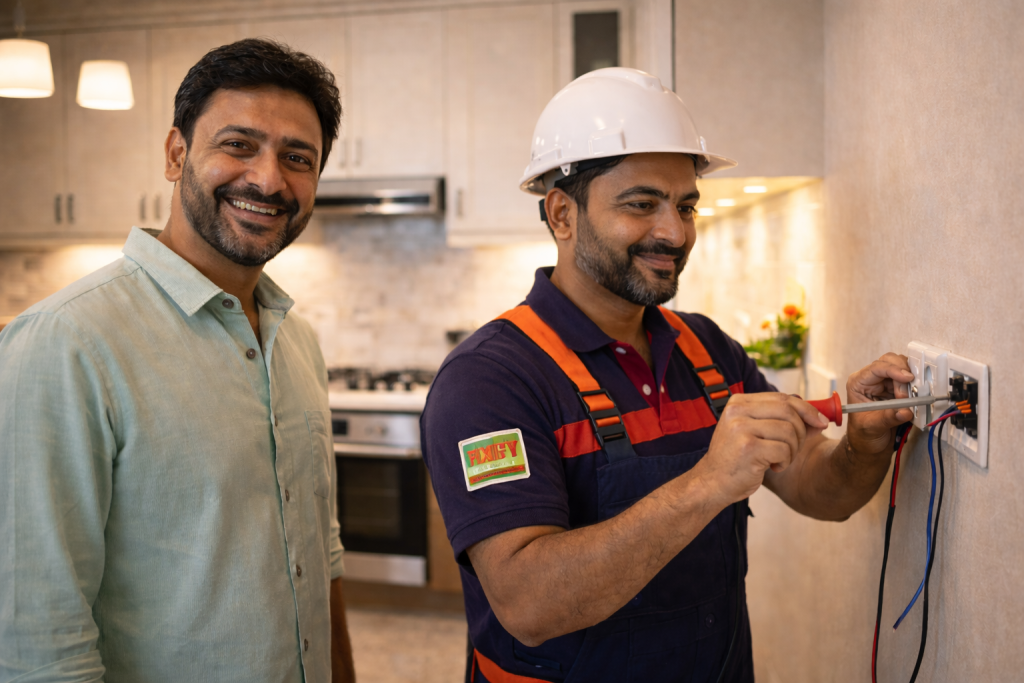
When something goes wrong at home, you want someone who shows up on time, does the job right, and doesn’t leave you guessing about the price. That’s what Fixify was built for.
- Certified electricians: Every technician is trained, verified, and experienced in residential electrical work
- 30-minute response: We serve all of South Delhi, Greater Kailash, Hauz Khas, Lajpat Nagar, Defence Colony, Saket, and more
- Transparent pricing: Subscribers pay ₹200/hr. Non-subscribers pay ₹300/hr + ₹50 convenience fee. No hidden charges.
- Easy to book: Download the Fixify app on Android or iOS and book in under two minutes
- 5/5 customer rating: Over 100 services completed with consistent five-star feedback
Beyond electrical work, our home repair services also include plumbing and carpentry, so you have one reliable number for everything your home needs.
Frequently Asked Questions
How long does a typical electrical repair take?
Most small repairs, such as a loose connection, a faulty switch, or a non-working socket, take 30 to 60 minutes. Larger jobs like wiring inspections, earthing repairs, or circuit upgrades typically take 2 to 4 hours. Your Fixify electrician will give you a time estimate before starting work.
What does electrical repair service cost in South Delhi?
Fixify charges ₹200 per hour for subscribers and ₹300 per hour plus a ₹50 convenience fee for non-subscribers. There are no hidden charges or surprise additions. The subscription pays for itself if you need even one or two services in a month.
Does Fixify provide emergency electrical service?
Yes. Fixify provides emergency electrical repair service across South Delhi, seven days a week. Whether it’s a tripped MCB at midnight or a burning smell from a socket on a Sunday morning, our electricians reach you within 30 minutes.
My MCB keeps tripping. What should I do?
Start by unplugging your appliances one by one and resetting the MCB after each one. This helps you identify whether a specific appliance is causing the trip. If the MCB trips even with everything unplugged, the problem is in the wiring calling an electrician immediately. Repeatedly resetting a tripping MCB without finding the cause is not safe.
Is getting a mild electric shock from a switch serious?
Yes, it is. A shock, even a mild one, means current is reaching a surface it shouldn’t. This is almost always caused by poor earthing or damaged insulation. It can get worse over time and can become dangerous, especially in households with children. Get your earthing inspected as soon as possible.
When does a home need complete electrical rewiring?
If your home is more than 15–20 years old, uses aluminium wiring, or you’re experiencing frequent MCB trips, persistent flickering, burning smells, or regular shocks, it’s worth having a full wiring inspection done. A Fixify electrician can assess your home and tell you exactly what needs attention and what doesn’t.
Final Thoughts
Electrical problems have a way of starting small and turning serious when ignored. A flickering light today can be a tripped circuit tomorrow and a fire hazard the week after. The good news is that most issues are completely fixable with the right help. If you’re dealing with any of the problems covered in this guide or just want a professional to inspect your home’s wiring before the monsoon, Fixify is here to help. Our certified electricians cover all of South Delhi and reach you within 30 minutes.